


Blue lights in the mirror. A tap on your window. In that moment, it’s easy to feel cornered—especially when the officer asks you to blow. I’ve spent over three decades defending Long Islanders in DWI cases, and this is one of the most common (and stressful) questions I hear: “Should I take the breath test?” Truthfully, it depends on which test we’re talking about, what the facts look like, and what risks you’re willing to take. Let me walk you through the decision the same way I would if you called me from the roadside or from the precinct.
There Are Two Very Different “Breath Tests”
-
The roadside screening test (often called a PBT or Alco-Sensor)
This is the small handheld device an officer may ask you to blow into at the scene. It’s a screening tool used to help the officer decide whether to arrest you. In New York, the roadside screening test is treated differently from the stationhouse “chemical” test. Refusing the roadside test is typically a traffic infraction, not a separate crime, and results from these devices are generally not used at trial the same way a chemical test is, though they’re often used for probable cause.
-
The stationhouse chemical test (breath, blood, or urine)
After arrest, police will ask for an evidentiary “chemical” test on a calibrated machine (or through blood/urine). New York’s implied-consent law makes refusal a big deal: it triggers an administrative DMV case, immediate license consequences, and it can be used as evidence at trial if proper warnings are given.
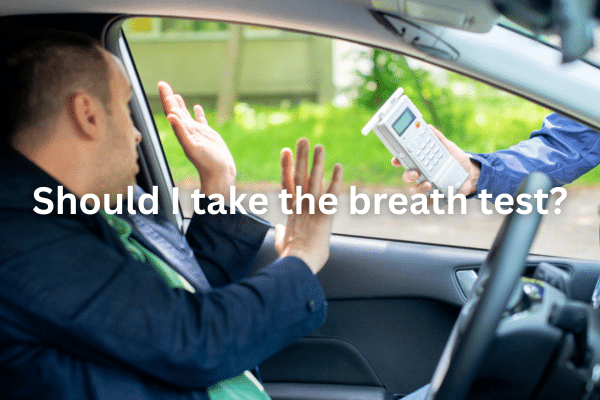
Should You Blow Into the Roadside Device?
For many drivers, there is little upside to the roadside PBT. If the officer already believes you’re impaired, a low PBT reading might not stop an arrest. If you refuse, you’ll likely still be arrested and you may get a ticket for refusing the screening test (again, generally a traffic infraction). The PBT result itself rarely becomes the centerpiece of a trial the way a chemical test does. In short: the roadside device doesn’t help you much, and refusal here does not carry the severe DMV penalties that come with refusing the chemical test.
Should You Take the Chemical Test at the Precinct?
This is the harder question, because a chemical test comes with real stakes either way.
If you take it:
- A result at or above .08 can support a “per se” DWI charge, and a very high result (e.g., .18 or more) can support aggravated charges. That number becomes central evidence at trial.
- On the other hand, if you truly had very little to drink and time has passed, a test below the legal threshold can be helpful.
If you refuse it:
- Your license is typically suspended at arraignment, and you face a DMV refusal hearing.
- If the refusal is sustained, the DMV generally revokes your license for at least one year (longer for repeat incidents), imposes a civil penalty (commonly $500 for a first refusal; higher in some scenarios), and you’ll owe New York’s Driver Responsibility Assessment ($250 per year for 3 years, total $750). These are administrative penalties and apply even if the criminal case ends well.
- A properly warned refusal can be shown to the jury as evidence of “consciousness of guilt,” which can complicate trial strategy.
Commercial drivers (CDL) and under-21 drivers face even tougher outcomes; CDL consequences can include permanent revocation in some circumstances, and under-21 drivers face Zero Tolerance rules. If you hold a CDL or are under 21, the calculus leans heavily toward a careful, case-specific plan.
“Do I Get to Call a Lawyer First?”
In New York, once you’re under arrest, you have a limited right to consult a lawyer before deciding on a chemical test—if you ask and if it won’t unduly delay the process. Courts have held that police shouldn’t block a reasonable chance to speak with counsel (including letting you know if your lawyer is trying to reach you), and in some cases, blocking that access has led to test results being suppressed. Practically, you should ask to call me as soon as you’re allowed.
Ignition Interlock and Other Downstream Effects
If you’re ultimately convicted of a DWI misdemeanor or felony in New York, the court will require an ignition interlock device during your sentence period, and your license will carry an ignition-interlock restriction. This is separate from the refusal decision, but it’s one more reason to think holistically about the case strategy from day one.
A Simple, Real-World Framework I Use with Clients
- Roadside PBT: It rarely helps you and usually isn’t decisive evidence at trial. Refusing can add a ticket, and you may be arrested either way. Many drivers decline this test politely. (You must still provide license/registration/insurance and follow lawful instructions.)
- Stationhouse chemical test:
- If you truly consumed little or no alcohol and significant time has passed, a chemical test might confirm you’re below the legal limit.
- If you likely exceed the limit, blowing creates strong per-se evidence. Refusing avoids giving the number, but it triggers immediate administrative penalties (suspension at arraignment, a DMV refusal hearing, likely revocation and civil penalties) and can be used against you at trial if warnings were proper. The refusal also adds a $750 Driver Responsibility Assessment over three years.
- CDL or under-21: Speak to me immediately. The added consequences can be career-altering, and the “best” choice often differs from a standard case.
- Already refused or already blew? We still have options: challenging the stop, the arrest, the warnings (they must be “clear and unequivocal”), machine maintenance, observation periods, and timing. I’ve won many cases on procedure, not just on the number.
What About Driving While the Case Is Pending?
If you blew .08 or higher, New York’s prompt-suspension law usually means your license is suspended at arraignment. You may seek a hardship privilege (a narrow court-issued permission for essential driving), and many people later qualify for a pre-conviction conditional license through the DMV after a short waiting period if they enroll in the Impaired Driver Program. If you refused, the court suspension and DMV hearing path are different—but there are still ways to keep limited driving privileges in some scenarios. Timing and paperwork matter, so talk to me right away.
Bottom Line from a Long Island DWI Defense Lawyer
There is no one-size-fits-all answer. The roadside PBT rarely helps you. The stationhouse chemical test presents a real trade-off: a number that may convict—or clear—you, versus refusal penalties that hit immediately and can be shown to a jury. The right move depends on your drinking history that night, your driving/stop facts, your license status (CDL? under 21?), and what we can reasonably anticipate from the evidence.
If you’re reading this before anything happens, save my number and ask to call me if you’re ever arrested. If you’re reading this after a stop: contact me now. I’ve defended thousands of people in Suffolk and Nassau Counties, and I’ve been voted Best Lawyer on Long Island for five consecutive years. I’ll move quickly to protect your license, your record, and your future. Call me for a free, confidential consultation.